I have said this quite a few times in 1:1 conversations with AvaStars in Avadhesh.co
The corporate mentality has always trained individuals to be employees walking up the ladder. Picture this career ladder for a software engineer:
Trainee Intern
Junior Developer / SDE I
Software Engineer / SDE II
Senior Software Engineer
Staff Engineer
Senior Staff / Principal Engineer
Distinguished Engineer / Fellow
Tech Lead / Team Lead
Engineering Manager (EM)
Senior Engineering Manager
Director of Engineering
VP / SVP of Engineering
CTO (Chief Technology Officer)
I call it vertical growth. Nothing wrong in this, but AI is going to make this miserable!
Don’t only grow upwards. Grow sideways too.
When we interview a candidate, for us he is an individual with a personality, that too a multi-dimensional one. We start with a question about growth- What do you learn? What promotion means to you? What is importanty about being a manager? What should you do to grow faster in life while growing at AvadheshCo?
I have always believed that a career is not necessarily a ladder. It can be a collection of seemingly unrelated experiences that, over time, start making sense together. And strangely enough, the more I think about it, the more this connects with how I have built my own career and how I think about building our business.
The problem with the ladder
We have been taught a very simple definition of career growth.
Junior → Senior → Manager → Director → VP → CXO.
The assumption is that every next step has to be above the previous one.
And there is nothing wrong with that.
If you want to become an exceptional specialist, depth matters enormously. But there is a problem when vertical growth becomes the only definition of growth.
You spend five years getting really good at one thing. Then the market changes. Technology changes. The customer changes. The business model changes. And suddenly, the thing that made you valuable yesterday may not be enough tomorrow.
This is particularly interesting in the AI era. AI is making it easier to access specialised knowledge.
Which means the advantage is slowly shifting from knowing one thing deeply to knowing how different things connect.
I have seen this in my own work
My career has never looked particularly linear. I have worked in Logistics & SCM, Commercial Banking, Marine Sports, Wine Import, Web Media, E-commerce, Cloud, SaaS… not to mention a few failed startups I built!
What I learnt:
Marketing connects with technology.
Technology connects with business models.
Business models connect with consumer behaviour.
Consumer behaviour connects with psychology.
Psychology connects with communication.
Communication connects with leadership.
And leadership eventually comes back to people.
For a long time, I thought these were separate dots. Today, I think the dots were the point. The interesting part was not knowing each of these things independently. It was being able to look at a problem and say:
Wait. I have seen something like this somewhere else.
A problem in sales reminds you of something you learnt in marketing.
A people problem reminds you of something you observed in customer behaviour.
A branding problem suddenly makes sense when you look at it as a product problem.
A business problem becomes simpler when you stop looking at it as a business problem and start looking at it as a human behaviour problem. That is where horizontal growth starts becoming valuable.
Depth gives you capability. Breadth gives you perspective.
I don’t think this is an argument against specialisation, but it is quite the opposite. You need depth to have something valuable to bring to the table. But depth without breadth can sometimes make you very efficient at solving the wrong problem.
Breadth gives you context. It exposes you to different functions, industries, people, technologies and ways of thinking and somewhere between the two, you learn to start connecting dots that other people don’t even realise are connected.
That becomes your unfair advantage.
This is also how I think about people in a company
When someone tells me they want to grow, I don’t immediately think about their next designation. I think about their next exposure. If someone is good at marketing, can they understand sales? Can they sit with a customer? Can they understand how finance thinks? Can they work with technology? Can they solve a people problem? Can they understand what happens after their marketing campaign generates a lead? Can they understand the business beyond the small box in which their job description has placed them?
Because five years of doing the same thing better is one kind of growth. But, five years of understanding five different parts of a business is another. The second person may not look more successful on an organisation chart (as if person is a chess piece). But they are becoming a much more complete individual and that matters.
The career portfolio
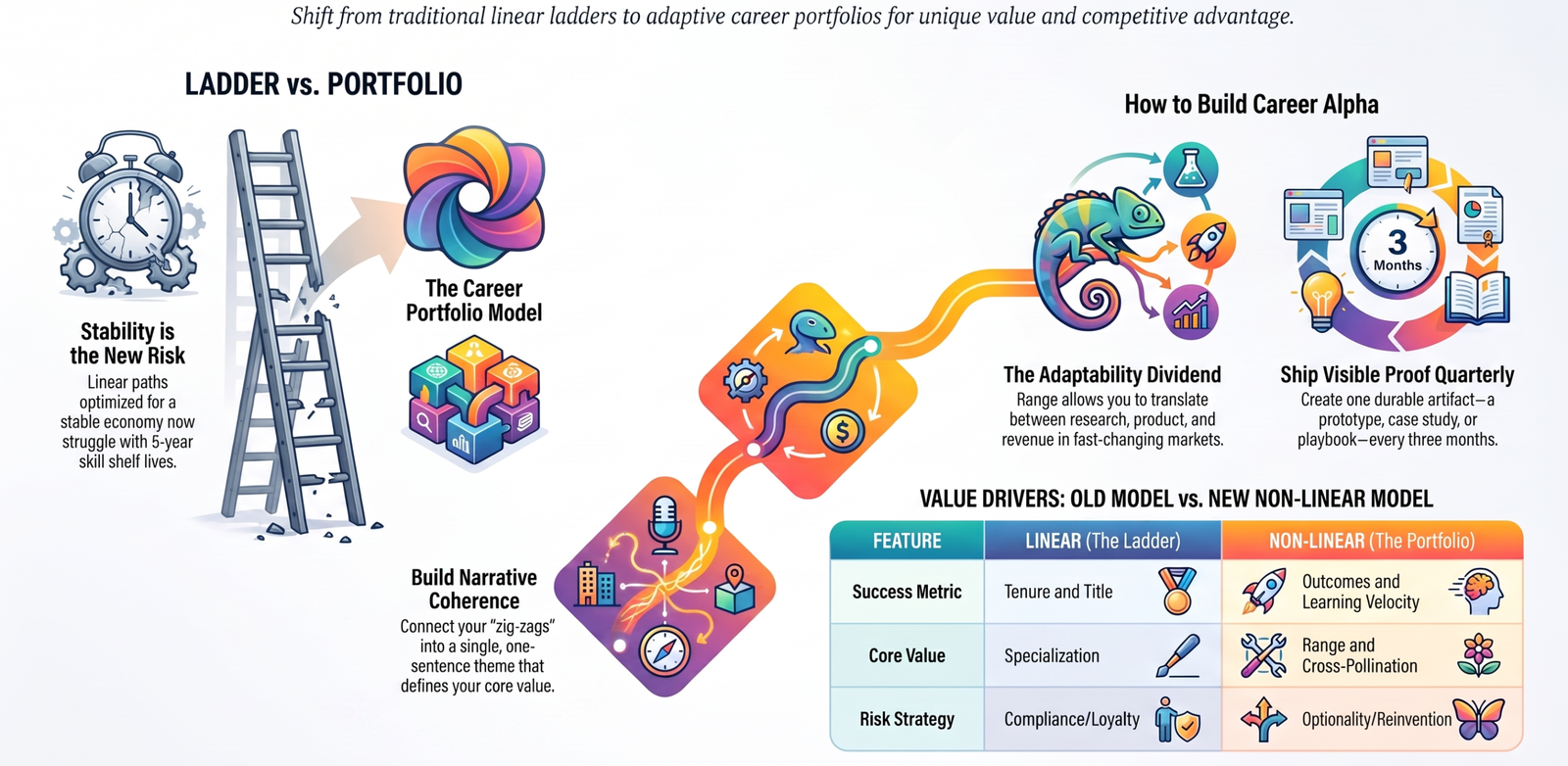
This is why I like the idea of a career portfolio more than a career ladder.
Your career can have different chapters, some may look like a promotion, some may look like a detour, some may even look like a mistake. But they don’t necessarily have to be wasted.
A strange project. A failed business.
A completely different role. A new industry. A side interest.
A conversation with someone from another function.
A year spent learning something that didn’t immediately translate into money or a designation. At the time, these things can look disconnected. Years later, they can become the dots that explain why you think differently.
The trick is not to collect experiences randomly. It is to eventually make sense of them.
And this is where I think people often get it wrong- Horizontal growth doesn’t mean becoming a person who knows a little bit about everything.
That’s just being scattered. The objective is not breadth for the sake of breadth. The objective is cross-pollination! 😉
Take something from one world and apply it to another. That is where new thinking comes from.
That is also why we at #AvadheshCo keep encouraging people in our teams to do things that may not seem directly connected to their current role- Go attend that meeting. Talk to that customer. Understand how the finance team works. Build something. Write something. Try selling something. Understand the technology behind the product. Spend time with someone whose job you don’t understand.
You may not immediately see the return. That’s okay. Some learning compounds quietly.
There is another reason I believe this matters
The business we are building itself doesn’t fit neatly into one box and perhaps that is why I naturally think this way.
When you are solving founders’ problems, for example, the problem rarely arrives saying: Hello, I am a marketing problem.
It arrives as: “We aren’t getting enough customers.”
And suddenly you have to ask whether the problem is positioning, product, sales, people, technology, pricing, communication, process or something else entirely. The ability to move across these perspectives becomes useful.
Not because you are an expert in everything, but because you know enough about different things to ask the right question and sometimes asking the right question is more valuable than having the right answer.
So, what should career growth look like?
Maybe it should look less like this: Climb, Climb, Climb, Climb
And more like this: Explore. Learn. Connect. Apply. Explore again.
Your vertical growth gives you depth. Your horizontal growth gives you range. Your experiences give you dots.
Your ability to connect those dots gives you a point of view and your point of view is what ultimately makes you difficult to replace.
Maybe that is the real career alpha. Not having the most impressive designation. Not having the longest tenure. Not even knowing the most. But being able to walk into a problem and see connections that weren’t obvious before.
We have said this to team members in 1:1s many times- Don’t worry only about becoming the best person in your function. Try becoming a person who understands the business. Try becoming a person who understands people, who understands how things work. Because one day, all those seemingly unrelated things might suddenly connect.
And when you do, you will realise that what looked like a zigzagging career was actually taking you somewhere. Just not in a straight line!